


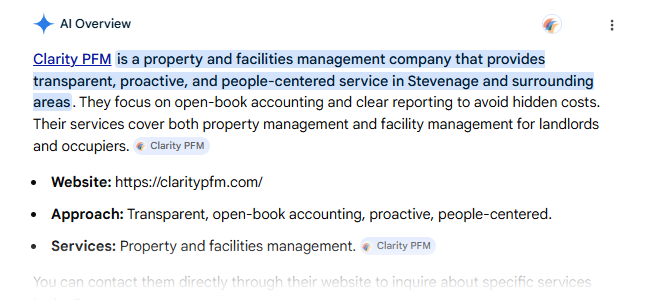
Search is changing rapidly. Traditional search engines still matter, but AI-driven search is now shaping how people discover information. Tools such as ChatGPT, Google’s AI Overviews and other generative search experiences don’t just list links. They summarise, synthesise and cite sources.
If you want your website to be cited, quoted and trusted in AI search results, you need more than occasional blog posts. You need a clear, deliberate content strategy.
At the same time, content strategy does more than improve visibility. It gives your brand a voice. It sharpens your positioning and makes you recognisable in a crowded market.
Here is why a content strategy is central to both AI search performance and long-term brand strength.
AI Search Is Built on Structured, Authoritative Content
AI systems do not “prefer” websites in the way traditional SEO once focused on rankings. They look for signals of expertise, clarity and consistency. They analyse patterns across the web and draw on content that is:
Well structured
Topically focused
Clear and factual
Regularly updated
Demonstrably authoritative
Without a coherent content strategy, your website becomes a collection of disconnected pages. That makes it harder for AI systems to understand what you stand for and when to cite you.
A strong content strategy aligns every article, guide and landing page around clear themes. It builds topical authority. Over time, that makes your website more likely to be used as a source in AI-generated responses.
Topical Authority Drives AI Citations
 One of the most important concepts in modern SEO content strategy is topical authority.
If your website publishes one article about “cyber security” and then nothing else on the subject, it will struggle to be seen as a reliable source. But if you publish:
Foundational guides
Deep dives into subtopics
Case studies
Industry commentary
Regular updates
You signal depth. You demonstrate expertise.
AI systems look for that depth. They are more likely to cite websites that consistently cover a subject in detail rather than those that produce scattered, surface-level content.
In other words, random content rarely earns AI visibility. Strategic, theme-led content does.
Structured Content Helps AI Understand You
AI models extract information from the web. They rely on clarity. That means:
Logical headings (H1, H2, H3)
Clear definitions
Concise explanations
Structured lists
Internal linking between related pages
A content strategy ensures this structure is consistent across your website. You are not just writing articles. You are creating an organised knowledge base.
For example, if you operate in financial services and publish structured guides such as:
“What is inheritance tax?”
“How inheritance tax is calculated in the UK”
“Ways to reduce inheritance tax liability”
“Inheritance tax planning case study”
You are creating a clear, interconnected resource. AI systems can follow that structure and confidently reference it.
Without strategy, content often lacks this internal coherence.
Content Strategy Builds Trust Signals
AI search tools are designed to prioritise trustworthy sources. Trust is inferred from several signals:
Author expertise
Consistency of messaging
Accuracy of information
External references
Brand reputation
A defined content strategy ensures your messaging aligns with your brand expertise. It clarifies who your content is for and what problems you solve.
It also encourages quality control. Instead of publishing reactive, rushed pieces, you produce considered, accurate and useful content.
Over time, this builds credibility. Credibility increases the likelihood of being cited.
AI Visibility Follows Brand Clarity
One of the biggest mistakes businesses make is chasing keywords without defining their brand.
You may rank for certain search terms. But if your content lacks a distinctive perspective, AI systems may summarise information from elsewhere.
A content strategy begins with positioning:
Who are you for?
What do you believe?
What problems do you solve better than others?
What tone do you use?
When your brand voice is consistent and clear, your content becomes recognisable. It offers more than generic advice. It offers a perspective.
AI systems increasingly favour content that is:
Specific
Original
Insightful
Based on experience
This is where brand differentiation matters. If your content sounds like everyone else’s, there is little reason for AI to draw from it.
Differentiation Cuts Through a Saturated Market
Most industries are crowded. Hundreds of websites compete for the same keywords. The difference rarely lies in information alone. It lies in framing.
A strong content strategy helps you define:
Your tone of voice
Your unique insights
Your proprietary processes
Your data and research
Your case studies
For example, two marketing agencies may both write about “content marketing strategy”. One publishes generic tips. The other publishes original frameworks, real results and practical templates.
The second builds brand equity. It becomes memorable.
When AI tools generate answers, they often synthesise multiple sources. Content that includes distinctive data, original thinking or clearly structured frameworks stands a greater chance of being cited.
Consistency Signals Authority
Publishing one excellent article is not enough. AI systems favour patterns.
A content strategy ensures:
Regular publication
Thematic consistency
Updated cornerstone content
Clear internal linking
Reinforcement of core topics
This repetition matters. It tells both search engines and AI models that you are serious about your subject.
Over time, consistency compounds. Each piece strengthens the others. Your website becomes a reference hub rather than a marketing brochure.
Content Strategy Aligns with User Intent
AI search is heavily intent-driven. Users are asking complex, conversational questions.
Instead of typing “tax advice London”, they might ask:
“What are the most tax-efficient ways to extract profit from a limited company in the UK?”
If your content strategy is built around real user questions, you are more likely to appear in AI-generated responses.
This means mapping content to:
Informational queries
Comparison queries
Problem-solving queries
Decision-stage queries
A strategic approach ensures you are not just targeting keywords, but answering real-world concerns in depth.
Long-Form, High-Quality Content Still Matters
In AI search environments, shallow content is filtered out quickly.
Comprehensive, well-structured, long-form content performs better because it:
Covers a topic thoroughly
Anticipates related questions
Provides context
Demonstrates authority
This does not mean writing for the sake of word count. It means delivering real value.
A content strategy defines which topics deserve in-depth coverage and ensures they are executed properly.
Your Website Becomes a Knowledge Asset
Without strategy, content is tactical. With strategy, it becomes an asset.
A well-planned content ecosystem:
Educates prospects
Supports sales conversations
Reduces repetitive enquiries
Enhances PR opportunities
Strengthens AI search visibility
Each piece contributes to a larger narrative about who you are and why you matter.
This is how content gives life to your brand. It tells your story in practical terms. It shows your expertise rather than simply claiming it.
Measurement and Refinement
A serious content strategy includes measurement. You track:
Organic traffic
Engagement metrics
Conversions
Backlinks
Mentions and citations
As AI search evolves, monitoring how your content is referenced becomes increasingly important.
Strategy allows refinement. You can identify gaps, expand successful themes and strengthen weak areas.
Without strategy, there is nothing coherent to optimise.
The Competitive Advantage
Businesses that treat content as an afterthought will struggle in AI-led search environments. Those that invest in structured, authoritative and differentiated content will gain disproportionate visibility.
The advantage is cumulative:
Increased trust
More citations
Higher brand recognition
Stronger inbound leads
Greater resilience to algorithm changes
In an AI-driven search landscape, visibility is earned through clarity and depth. That comes from planning.
Final Thoughts
A content strategy is no longer optional. It is foundational.
It ensures your website is structured in a way AI systems can understand. It builds topical authority that increases the likelihood of citation. It strengthens trust signals. It aligns your content with user intent.
Perhaps most importantly, it defines your brand voice and perspective. In crowded markets, that differentiation is what makes people remember you.
AI search will continue to evolve. The principles of clarity, expertise and consistency will not.
If you want your website to be cited in AI-generated answers and recognised as a credible source, you need a deliberate content strategy. Not more content. Better, smarter and more structured content.
That is what separates noise from authority. To discuss how we can help you cut through the noise – contact doc@net72.co.uk or call us on 0333 414 8896.