


Published April 2026 | A comprehensive look at how artificial intelligence is reshaping UK corporate marketing, sales, and customer engagement — and what organisations must do to stay competitive.
Introduction: A Tipping Point for British Business
The conversation around artificial intelligence has moved decisively from “should we explore this?” to “how fast can we deploy it?” For UK businesses, that shift is both an opportunity and a test. The organisations that move with confidence — those that learn from early adopters, address blockers honestly, and focus investment where the returns are clearest — will pull ahead. Those that wait risk being outpaced not just by global rivals, but by the UK businesses next door.
This article examines where UK corporates stand on AI adoption, maps out how platforms like the Vendasta AI Workforce can be deployed to attract and retain customers, and offers a frank assessment of where the blockers lie — and where the biggest commercial gains can be found.
Key Statistics at a Glance: AI Adoption Infographic
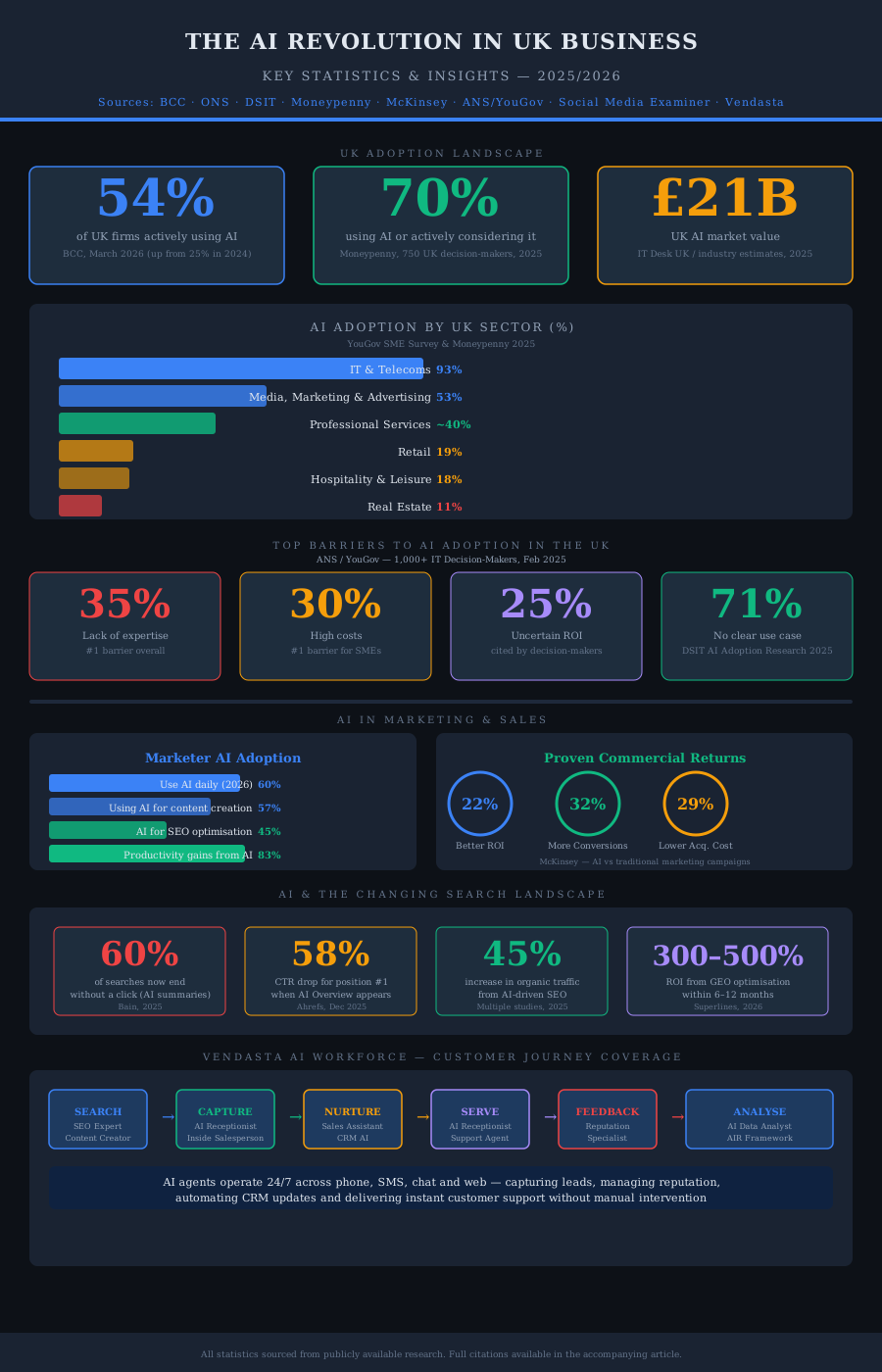
See the interactive infographic below, summarising the key data points from this article.
Part 1: The State of AI Adoption Among UK Corporates
Where We Are Right Now
The headline number tells a story of rapid acceleration. According to the British Chambers of Commerce, 54% of UK firms were actively using AI as of early 2026 — up from 35% in 2025 and just 25% in 2024. That is a near-doubling of adoption in under two years, a pace rarely seen in enterprise technology. At the same time, data from Paragon Bank suggests a narrower figure of 31–35%, reflecting the significant gap between surface-level experimentation (a ChatGPT subscription here, a Microsoft Copilot licence there) and structured, strategically embedded AI use.
The Office for National Statistics’ Management and Expectations Survey offers a more conservative benchmark: in 2023, just 9% of UK firms had formally adopted AI, while cloud-based computing systems had reached 69%. That gap between cloud and AI adoption is now closing fast, but it underlines that even among firms claiming AI use, depth of integration varies enormously.
A Moneypenny survey of 750 UK decision-makers conducted in early 2025 found that 39% of businesses were using AI in some form and a further 31% were seriously considering it — putting total interest (usage or intent) at nearly 70%. Only 28% described themselves as “fully embracing” AI across the organisation, while 40% were adopting it selectively in specific areas. Just 12% had no plans to adopt at all.
Who Is Leading and Who Is Lagging
Sector performance varies sharply. IT and Telecoms lead with 93% of businesses either fully embracing or selectively using AI, followed by media, marketing, and advertising at 53%. At the other end, real estate sits at just 11%, with transportation and distribution at 15%, hospitality and leisure at 18%, and both manufacturing and retail at 19%.
Company size is an equally significant factor. Among organisations with 250 or more employees, AI adoption reaches 44% — but for SMEs, the figure remains substantially lower. Among sole traders, 42% have no plans to adopt AI whatsoever, and a further 31% are using it only in a limited way. As the Moneypenny report noted, this largely reflects access: to budget, time, skills, and confidence — not a fundamental scepticism about AI’s value.
Research from YouGov among 1,000 SME decision-makers found that, even among adopters, nerves run high: 48% worry AI could negatively affect employees’ critical thinking, 42% cite legal risks, and 58% are concerned that over-reliance on AI could reduce business creativity.
The Marketing Function: A Natural Beachhead
Marketing consistently shows higher AI adoption than almost any other business function, and for good reason — the tasks are well-matched to what current AI tools do best. Research from the Social Media Examiner found that 60% of marketers now use AI every day, a significant jump from 37% in 2024, with 84% increasing their usage over the past year. Among engineering companies surveyed at a specialist event in late 2025, 66% had used AI to help with marketing strategy — though primarily for text generation rather than deep strategic analysis.
Jasper’s 2025 State of AI in Marketing report, drawing on more than 500 marketers, found that 63% of organisations are already using generative AI, with increased productivity (28%) and improved marketing ROI (25%) identified as the top two benefits. Content creation (57%) and idea generation (55%) are the most common use cases, with SEO and marketing optimisation at 45%, and research and analysis growing fast.
Part 2: How AI Is Transforming Customer Attraction and Retention
The Case for AI-Powered Customer Engagement
The case for AI in customer-facing functions is no longer theoretical. McKinsey research shows that AI-driven campaigns deliver 22% better ROI, 32% more conversions, and 29% lower customer acquisition costs than traditional approaches. Separately, businesses investing in AI are seeing revenue increases of 3–15% and sales ROI uplifts of 10–20%. These are not marginal gains — they represent a structural competitive advantage for early movers.
The customer journey has also shifted. Today’s buyers conduct more research before engaging, form opinions based on online reputation long before speaking to a salesperson, and expect immediate responses across multiple channels. AI addresses each of these moments directly.
The Vendasta AI Workforce: A Practical Model for UK Businesses
An example is Vendasta’s AI Workforce, which is available in the UK from Net72, that offers a concrete illustration of how integrated AI deployment can work in practice. Rather than a single tool, it is a collection of purpose-built AI agents — each trained for a specific role in the customer journey — that operate within a unified platform alongside CRM, marketing automation, scheduling, and reporting capabilities. Crucially, none of these require technical expertise or lengthy setup; they connect to business data and begin working immediately.
The AI Workforce covers the full customer lifecycle across eight core roles: an AI Receptionist, an AI Reputation Specialist, an AI Sales Assistant, an AI Data Analyst, an AI Inside Salesperson, an AI Support Agent, an AI Content Creator, and an AI SEO Expert (with the latter two currently in development). Businesses can also build Custom AI Employees trained on their own documents, workflows, pricing, and rules — extending automation into the processes unique to each organisation.
Lead Generation: Capturing Interest Before Competitors Do
Lead capture is one of the highest-impact AI applications in sales and marketing. The Vendasta AI Receptionist handles inbound enquiries across phone, chat, SMS, and connected websites — answering questions, promoting products, booking appointments, and capturing contact details into the CRM, all without human involvement. The AI Inside Salesperson takes this further: using a structured discovery process to qualify leads, handle objections, and book high-value meetings 24 hours a day, seven days a week.
The commercial logic is straightforward. Leads that receive an immediate, helpful response are significantly more likely to convert. AI eliminates the response latency that causes many inbound leads to go cold before a human sales team can engage them.
SEO and Content: Getting Found in an AI-Transformed Search Landscape
The impact of AI on search is perhaps the most dramatic change in digital marketing over the past two years. Google’s AI Overviews now appear for approximately 13% of US desktop queries (a figure that doubled in the first three months of 2025 alone), and 60% of searches in traditional search engines now end without a click due to AI-generated summaries. Position-one organic click-through rates have fallen by up to 58% where AI Overviews appear.
This is not, however, a reason to abandon SEO — it is a reason to evolve it. Businesses that appear as cited sources within AI Overviews see measurable increases in click-through rate. AI-driven SEO campaigns can deliver a 45% increase in organic traffic and a 38% rise in e-commerce conversions when implemented correctly. The shift is from keyword-ranking optimisation to authority-building optimisation: content that is factually rich, well-structured, fast-loading, and cited from credible sources is far more likely to be surfaced by AI systems than content optimised purely for traditional ranking signals.
Vendasta’s AI Content Creator and forthcoming AI SEO Expert address this directly — drafting and scheduling content for websites, blogs, and social media while the SEO agent analyses keywords and recommends visibility improvements. For businesses that lack dedicated content and SEO teams, this represents access to capabilities that would previously have required specialist agency support.
Reputation Management: Online Trust as a Competitive Asset
Online reputation has become one of the most commercially significant factors in customer acquisition — particularly in local and service-based markets. The Vendasta AI Reputation Specialist automates review requests, generates personalised responses to reviews (both positive and negative), posts content on behalf of the business, and provides AI-driven analysis of trends across review platforms. It uses a built-in chat interface to surface actionable insights from the data it monitors.
The commercial case for this is clear: buyers research online before purchasing, and businesses with strong review profiles convert at higher rates. AI makes systematic reputation management — which most businesses perform inconsistently or not at all — a continuous, low-cost process.
Customer Retention: Personalisation at Scale
Retention is where many businesses underinvest. The Vendasta platform addresses this through its AI Sales Assistant (which keeps CRM data current and identifies next-best-action opportunities), its AI Inside Salesperson (which re-engages previous customers at optimal times with personalised messages), and its AI Support Agent (which resolves customer queries via SMS and chat using the HEARD framework — Hear, Empathise, Apologise, Resolve, Diagnose — without hold times or escalation delays).
AI-powered personalisation at scale is something that previously only large enterprises with major CRM investments could deliver. Platforms like Vendasta make it accessible to businesses of all sizes, which is particularly significant for UK SMEs competing against larger national players.
Part 3: Fears and Blockers — What Is Holding UK Businesses Back
The Real Barriers to Adoption
Despite growing awareness, a clear picture of where adoption stalls has emerged. The UK Government’s own AI Adoption Research (commissioned through DSIT and conducted across 3,500 businesses in early 2025) found that 60% of businesses cited limited AI skills and expertise as a key blocker, while 71% said they had not identified a clear use case for AI in their organisation.
A February 2025 survey by ANS and YouGov of over 1,000 IT decision-makers identified lack of expertise as the single largest barrier at 35%, followed by high costs (30%) and uncertainty around return on investment (25%). Regulatory compliance was the primary concern for large businesses, while cost was the dominant barrier for smaller ones.
Microsoft’s 2025 Work Trend Index adds a further dimension: 47% of employees still treat AI as a simple command-based tool — ask a question, receive an answer. The other half, who use AI as a thinking partner and workflow integrator, see substantially better results. The barrier is rarely the technology itself; it is the absence of training, structured use cases, and leadership commitment.
Data Security and Privacy Concerns
Data privacy is a consistent concern, particularly in the context of GDPR compliance. Businesses worry about what happens to their proprietary data when it is processed by AI systems — especially whether it might be used to train external models. Vendasta explicitly addresses this: the platform does not share proprietary business data for training large language models without consent, providing businesses with the assurance that their competitive information remains protected.
Fear of Job Displacement
Concern about job displacement — both among employees and among leaders worried about cultural resistance — is real and should be acknowledged rather than dismissed. A YouGov SME survey found that 34% of respondents cited the threat of job losses as a concern. The evidence, however, broadly supports a collaborative rather than replacement model. AI employees in platforms like Vendasta are explicitly designed to handle repetitive, time-consuming tasks — lead capture, CRM updates, review responses, scheduling — freeing human teams for strategy, creativity, and relationship management.
Change Management and Skills Gaps
The DSIT research found that the most commonly planned AI investments over the next twelve months include implementing off-the-shelf AI applications (65%) and embedding AI into existing tools and systems (59%). What these numbers also reflect is that most businesses are looking for managed, low-friction entry points — not bespoke AI development projects. This is precisely the market that platform-based AI suites serve, and it explains why adoption of ready-made AI tools is outpacing custom AI development across the UK business community.
Part 4: Where Organisations Get the Biggest Bang for Their Buck
Prioritising the Highest-ROI Applications
Not all AI use cases deliver equal commercial value. Based on available evidence, the areas that consistently deliver the clearest, fastest returns for UK businesses are customer service automation, marketing content and SEO, lead qualification, and CRM data management.
AI chatbots and virtual receptionists now handle up to 70% of customer service interactions across industries. AI-powered automation can reduce operational costs by up to 30%. Marketing functions using AI report productivity gains consistently in the region of 83%. These are not aspirational projections — they are outcomes being reported by current adopters.
For most UK SMEs and mid-market organisations, the highest-impact starting point is the combination of lead capture automation and reputation management — two functions that directly affect the top of the funnel and that currently consume disproportionate manual resource in organisations that have not automated them. The next layer — content creation, CRM hygiene, and personalised re-engagement — builds on that foundation to drive conversion and retention.
The Importance of Starting Small and Scaling
The Government’s DSIT research found that 40% of UK businesses are adopting AI selectively in specific areas, building experience and confidence before scaling. This is a rational approach — and platforms like Vendasta that offer modular AI agents support it directly. Businesses can begin with a single AI employee (such as the Receptionist or Reputation Specialist), measure the impact, and expand from there.
The risk of the incremental approach is insufficient ambition. Organisations that limit AI to one or two peripheral tasks without building institutional knowledge or structured workflows miss the compounding benefits that come from deeper integration. The businesses seeing the strongest returns — McKinsey identifies just 6% of organisations as genuine AI high performers — are those that have moved beyond experimentation to systematic, measured deployment with clear governance.
The Competitive Window Is Narrowing
Only 1% of organisations globally describe their AI rollout as “mature,” and just 6% qualify as high performers seeing meaningful financial returns. This means the window for competitive differentiation through AI adoption is still open — but it is narrowing. As the British Chambers of Commerce data shows, adoption has near-doubled in a year. The businesses that establish AI-powered sales, marketing, and customer service workflows now will build compounding advantages in search visibility, reputation, and customer loyalty that will be difficult for slower movers to close.
Conclusion: From Awareness to Action
The AI opportunity for UK businesses is not speculative — it is documented, measured, and increasingly well-evidenced. The barriers are real too, but they are addressable: most reduce to skills, clarity of use case, and change management rather than fundamental technical or financial obstacles.
For organisations looking to move from awareness to action, the practical path forward involves three steps: identify the one or two areas in marketing, sales, or customer service where AI would have the most immediate commercial impact; choose a platform that removes technical friction and connects to existing business data; and build the internal knowledge and governance structure that turns tool adoption into strategic capability.
The Vendasta AI Workforce represents one mature, integrated option for businesses — particularly agencies and multi-location operators — seeking to deploy AI across the full customer journey without building bespoke solutions. But whatever platform a business chooses, the imperative is the same: the time to act is now, the use cases are proven, and the competitive cost of waiting is rising with every quarter.
Sources and References
| # | Source / Publication | Key Claim / Data Point | Date | Link |
|---|---|---|---|---|
| 1 | British Chambers of Commerce / Paragon Bank | 54% of UK firms actively using AI (March 2026), up from 35% in 2025 and 25% in 2024 | March 2026 | salesandmarketingengineers.co.uk |
| 2 | Moneypenny — The State of AI Adoption in UK Businesses 2025 | 39% of UK businesses using AI; 70% using or considering; 28% fully embracing; 12% with no plans | February 2026 (fieldwork Apr–May 2025) | moneypenny.com |
| 3 | Office for National Statistics — Management and Expectations Survey | 9% of UK firms formally adopted AI in 2023; 69% using cloud computing; management practice scores correlate with AI adoption | March 2025 | ons.gov.uk |
| 4 | UK Government DSIT / IFF Research / Technopolis Group — AI Adoption Research | 60% cite limited AI skills as key blocker; 71% haven’t identified clear use case; 65% plan off-the-shelf AI apps | 2025 (fieldwork Feb–May 2025) | gov.uk |
| 5 | ANS / YouGov — Major Barriers to AI Adoption in UK Businesses | Lack of expertise 35%; high costs 30%; uncertain ROI 25%; 56% prioritise operational efficiency | February 2025 | techuk.org |
| 6 | YouGov B2B Omnibus — UK SME AI Survey | 31% of SMEs using AI; IT/telecoms 56%, Marketing 53% lead sectors; 48% fear impact on critical thinking; 34% worry about job losses | August 2025 | yougov.com |
| 7 | Social Media Examiner — AI Report 2025 | 60% of marketers use AI every day in 2026 (up from 37% in 2024); 84% increased usage over the past year | 2025 | socialmediaexaminer.com |
| 8 | Jasper — 2025 State of AI in Marketing | 63% of organisations using generative AI; top benefits: increased productivity (28%), improved marketing ROI (25%); 57% use it for content creation | 2025 | jasper.ai |
| 9 | McKinsey — AI in Marketing and Business Performance | AI-driven campaigns: 22% better ROI, 32% more conversions, 29% lower acquisition costs; 3–15% revenue increase; 10–20% sales ROI uplift | 2025 | mckinsey.com |
| 10 | McKinsey — Global State of AI 2025 | 88% of organisations use AI in some form; only 1% describe rollout as “mature”; 6% are high performers with meaningful financial returns | 2025 | mckinsey.com |
| 11 | IT Desk UK — AI Statistics 2025 | UK AI market worth £21 billion; AI chatbots handle up to 70% of customer service interactions; AI automation reduces operational costs by up to 30% | 2025 | itdeskuk.com |
| 12 | Ahrefs — AI Overviews Impact Study | Position-one CTR reduced by 58% where AI Overviews appear (December 2025) | December 2025 | ahrefs.com |
| 13 | Bain — AI Summaries and Search Behaviour | 60% of searches in traditional search engines now end without a click due to AI summaries | February 2025 | bain.com |
| 14 | Marketing LTB / Multiple Studies — AI SEO Statistics | AI-driven SEO campaigns: 45% increase in organic traffic; 40% higher click-through rates; 63% of websites using AI for SEO report improved rankings within 3 months | 2025 | marketingltb.com |
| 15 | Superlines — GEO ROI Research | Companies seeing positive Generative Engine Optimisation (GEO) ROI report 300–500% returns within 6–12 months | 2026 | seomator.com |
| 16 | ProfileTree — AI Adoption Rates in UK SMEs | 45% of SMEs integrated at least one AI solution by 2024, up from 25% in 2022; 65% of medium-sized enterprises have implemented AI in at least one department | February 2026 | profiletree.com |
| 17 | Microsoft — AI Economy Institute Global AI Adoption Report H2 2025 | Global AI adoption rose 1.2 percentage points in H2 2025; roughly 1 in 6 people worldwide now use generative AI tools | January 2026 | microsoft.com |
| 18 | Microsoft — 2025 Work Trend Index | 47% of employees still treat AI as a simple command-based tool rather than a thinking partner and workflow integrator | 2025 | microsoft.com |
| 19 | Vendasta — AI Workforce Platform | AI Workforce covers full customer lifecycle: Receptionist, Reputation Specialist, Sales Assistant, Data Analyst, Inside Salesperson, Support Agent, Content Creator, SEO Expert | 2025–2026 | vendasta.com/ai-workforce |
| 20 | Sales and Marketing Engineers — AI Adoption in Business 2026 | 60% of marketers use AI daily; skills gap is single biggest adoption barrier (not budget); 61% of engineering firms name skills and change management as primary obstacle | March 2026 | salesandmarketingengineers.co.uk |